Begin with the color fields
Color need not obey local appearance; broad reds, blues and greens push and pull one another, setting distance between figure and room.
Complete free archive
Matisse-like color blocks use bright flat color, cut-paper shapes and flowing lines to turn the image into a rhythmic color composition.
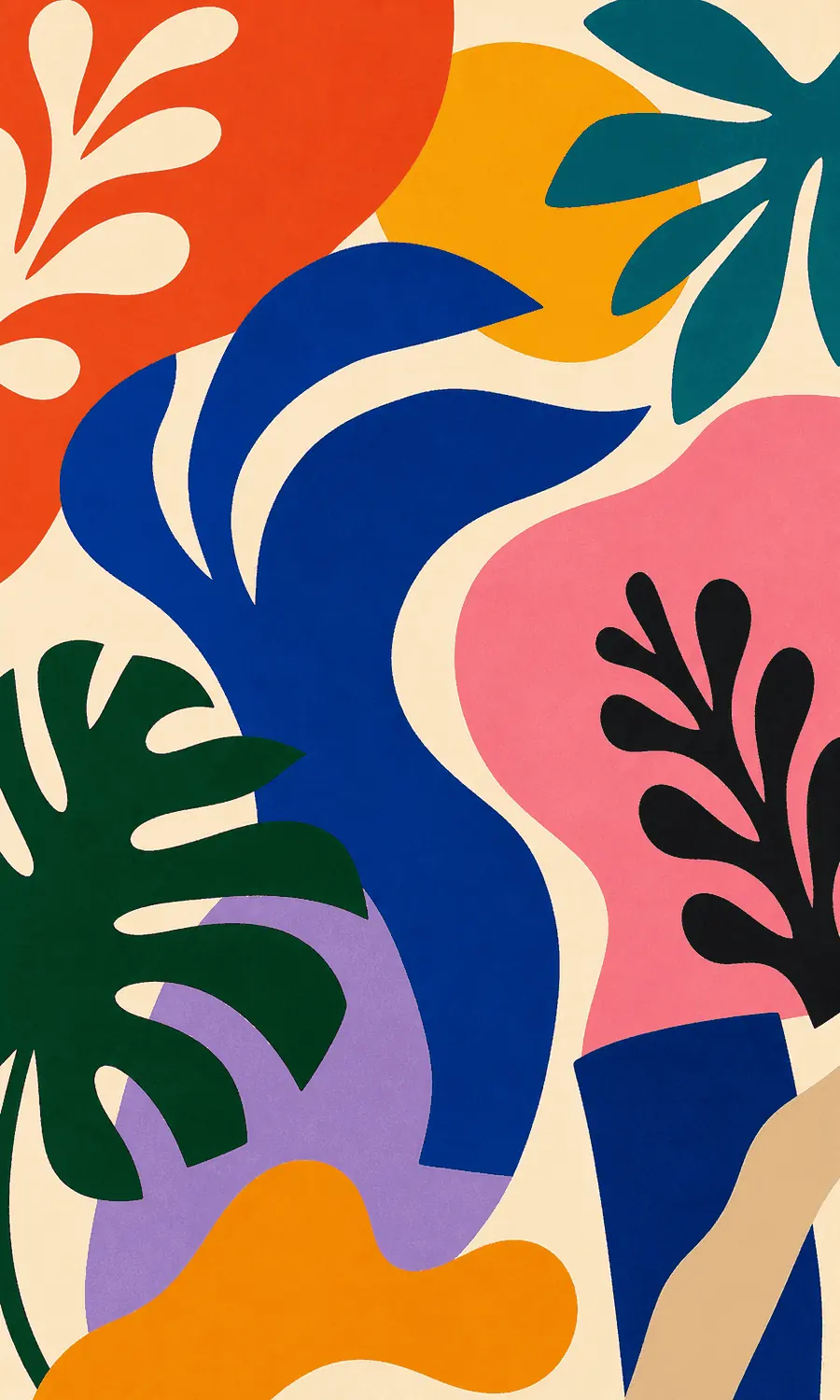
When wall, table and figure become broad fields of color, has space vanished, or learned to breathe in a flatter way?
Color need not obey local appearance; broad reds, blues and greens push and pull one another, setting distance between figure and room.
Simplified lines circle bodies, furniture and plants, separating shapes while carrying the eye with the rhythm of handwriting.
Wallpaper, rugs, windows and figures share flat pattern; depth is compressed yet survives through overlap and color difference.
These are comparative observation levels, not ratings of artistic value or quality.
When viewing Matisse-like color blocks, first see whether the colors dance, then watch how cut-paper edges and open space let the image breathe. The point is not likeness, but color, shape and rhythm becoming light and alive.
He worked this way because bright color blocks could bypass traditional light-and-shadow modeling and create a lively decorative space immediately. Cut paper let him 'draw with scissors': color sets the mood, contour sets rhythm, and the spacing between blocks gives the image its breathing room.
Like cutting gardens, dance and sunlight into colored paper, then arranging them into a breathing image.
See how walls, textiles, plants and windows answer one another through broad color, making pattern part of the room rather than an accent.
Attend to the relation between a complete silhouette and two or three colors, letting line and field organize the body without copying a specific cutout.
Find color echoes among a person, wall, cloth or plant, using a frontal composition to compress depth while preserving overlap.
Look at plates, book covers and cut paper to see how continuous contour and unmodulated color create buoyant rhythm.
Shared qualities: Both release color through non-natural hues, simplified contours and direct handling.
Different choices: Fauvism names a concentrated group practice; Matisse's longer language continued through decorative interiors, flattened space, flowing line and late cut-paper rhythm.
Shared qualities: Both rethink figure, still life and interior without obeying traditional perspective.
Different choices: Matisse often preserves sensuous continuity through broad color, contour and pattern; Cubism more often fractures objects, interlocks positive and negative space, and compresses several views.
Replicate the visual language of late Matisse cut-outs and color blocks: bright saturated flat color, cut-paper edges, botanical leaf shapes, dance-like curves, sunny decorative rhythm, generous negative space, minimal shadow and realism, original poster or cover case, not a copy of a specific Matisse artwork
Avoid photorealism, heavy oil-paint texture, complex perspective, muddy colors, directly copying The Snail or any specific composition
Henri Matisse (1869-1954) was a major French modern artist and a central figure of Fauvism. He treated color not as decoration on objects, but as a direct tool for emotion, space and rhythm. In his late years, limited physically, he cut shapes from gouache-painted paper and arranged them with studio assistance, developing his celebrated cut-outs. The Matisse-like color block language is therefore not childish simplicity, but a concentrated structure of painting, decoration, space and bodily movement.
Do you need perspective to believe in a room, or are color, contour and overlap enough?