First, notice symmetry
A central axis holds the image like an architectural entrance, with mirrored forms creating ceremony.
Complete free archive
Art Deco combines geometric order, metallic shine and urban luxury, like the visual language of 1920s-30s cinemas, ocean liners and skyscrapers.
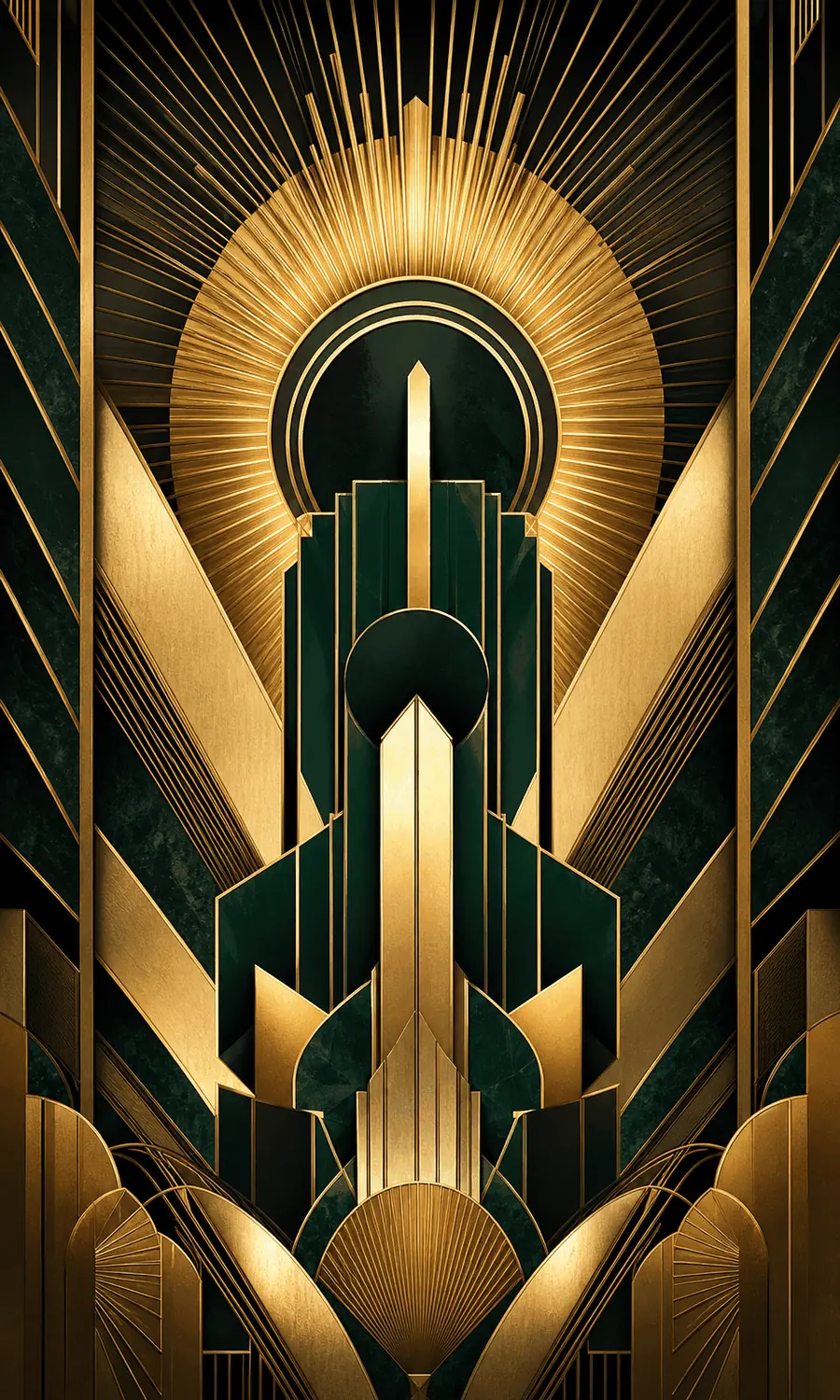
If this image were a building, would you walk toward its central entrance or look up at its rising silhouette first?
A central axis holds the image like an architectural entrance, with mirrored forms creating ceremony.
Gold, black, ivory and jewel tones make the flat surface feel like metal, lacquer or inlay.
Steps, points and sunbursts keep lifting the eye, like a skyline celebrating modern speed.
These are comparative observation levels, not ratings of artistic value or quality.
Read Art Deco by silhouette first: does it rise like an architectural facade? Then read the shine: metal, black, ivory and deep green push the image toward luxury.
It answers the modern city's desire for new luxury: industrial speed and geometry, but also expensive craft and material. Stepped forms, sunbursts, gold and symmetry became its signature.
Like the neon facade of a Golden Age cinema: symmetrical, sharp and glowing.
Look for repeated fans and stepped lines in lamps, mirrors or cabinets; one strong accent can be enough.
Notice how straight silhouettes, metal hardware and geometric jewelry add ceremony.
Find the central axes of entrances, stairs and corridors, then place the subject inside that symmetry.
Notice how perfume bottles, cinema signs and chocolate boxes use black-gold palettes, sunbursts and clipped corners to build a clear decorative order.
Shared qualities: Both value ornament and extend one visual language across architecture, posters and objects.
Different choices: Art Deco is geometric, symmetrical and machine-age; Art Nouveau is organic, handmade and plant-like.
Shared qualities: Both can become recognizable through clear silhouettes.
Different choices: Art Deco builds grandeur through repetition and material; Minimalism removes ornament so space and proportion take the lead.
Art Deco luxury event poster, black gold ivory palette, symmetrical geometric composition, sunburst rays and stepped skyscraper silhouettes, metallic finish, Jazz Age glamour, high-resolution original poster, not copying a specific building or historical poster
Avoid cheap gold gradients, excessive 3D, Baroque ornament mixed in, cyberpunk neon mood, copying a specific film poster or building facade
Art Deco became strongly associated with the 1925 Paris Exposition Internationale des Arts Decoratifs et Industriels Modernes and flourished between the world wars in Europe and the United States. Its sources include the machine age, Egyptomania, the Jazz Age, modern architecture and luxury craft.
Are you drawn to its ceremony, or does the ornament feel too full?