First, notice the flying line
Ribbons, clouds and body poses form continuous curves that make a still wall feel choreographed.
Complete free archive
Dunhuang mural style fuses Buddhist narrative, flying apsaras, mineral color, line drawing and Silk Road culture on cave walls, solemn yet full of movement.
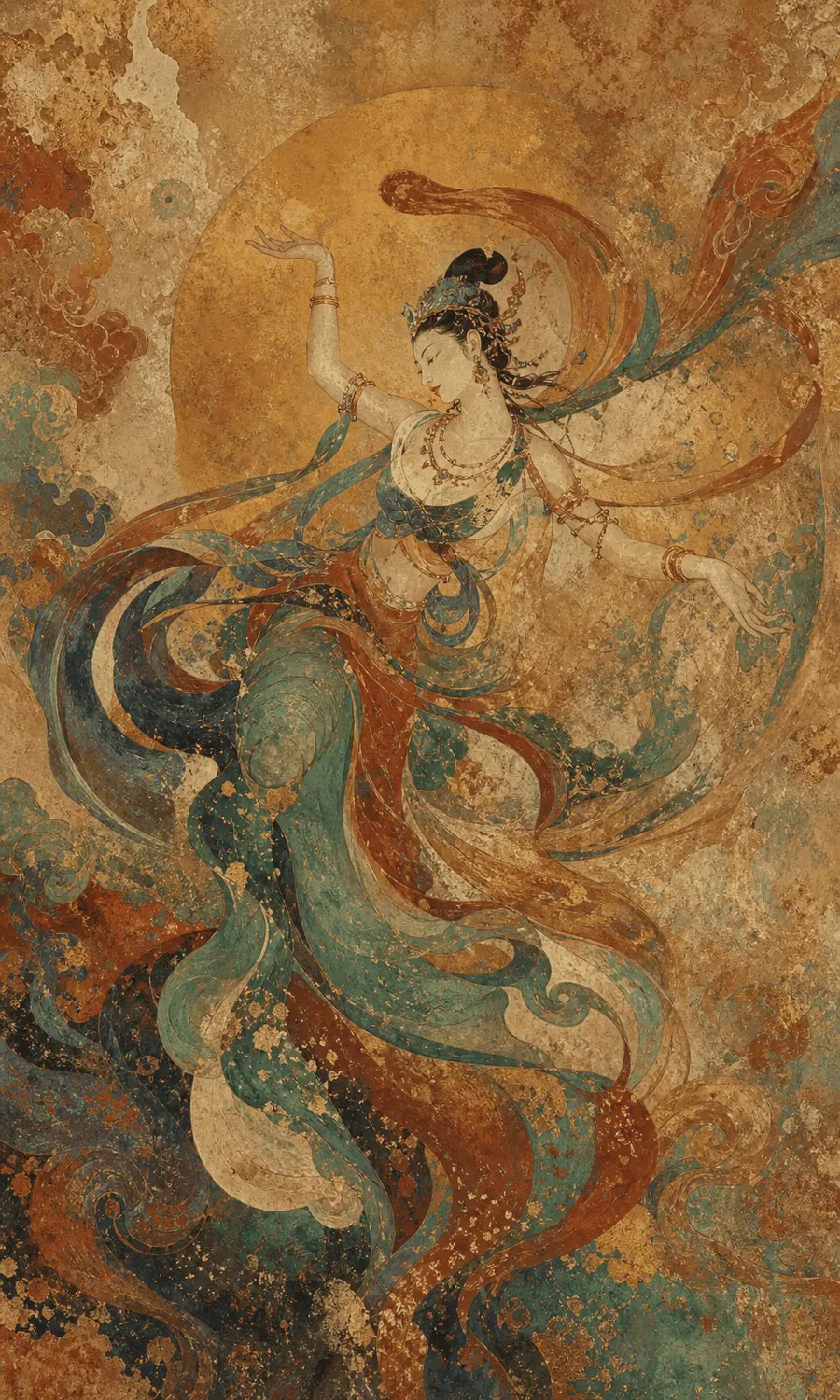
Follow the figures and ribbons: are they standing on the wall, or circulating through it like music?
Ribbons, clouds and body poses form continuous curves that make a still wall feel choreographed.
Earth red, mineral blue, green and ochre carry both contrast and the warmth of an aged wall.
Figures, motifs and architecture often circle a center or unfold in bands, turning sacred narrative into visual order.
These are comparative observation levels, not ratings of artistic value or quality.
Do not look only for apsaras. See how posture, drapery lines, mineral color and aged wall texture create sacred space together.
The images served devotion, storytelling and cave space, so figures are solemn, ribbons and clouds flow, and mineral pigments give weight and durability.
Like a mineral-colored wind blowing flying ribbons out of a cave wall.
Notice how tapestries, scrolls or long walls use horizontal rhythm to carry several moments.
Focus on ribbons, layered folds and mineral palettes so movement and color travel together.
Use lateral movement, long fabric or sequential poses to organize one frame like a dance.
Look for rhythmic scrolls, lotus forms and banded motifs on books, textiles and vessels.
Shared qualities: Both value expressive line and space through which the eye can travel.
Different choices: Dunhuang murals rely on mineral color, wall narrative and dense ornament; ink painting relies on tonal ink, bare paper and breathing brushwork.
Shared qualities: Both organize narrative through detailed figures, architecture, plants and ornament.
Different choices: Dunhuang murals belong to cave and sacred space, with larger scale and enclosure; Persian miniatures concentrate detail within a handheld manuscript page.
Dunhuang mural visual language, mineral pigment texture, ochre red malachite green lapis blue palette, flying apsara ribbons and lotus patterns, aged cave-wall surface, Buddhist narrative atmosphere, solemn flowing original mural-style illustration, not copying a specific cave mural
Avoid modern fantasy-game styling, cheap golden glow, random religious symbol mixing, AI pseudo-Sanskrit gibberish, direct copy of a specific Mogao mural
The Mogao Caves near Dunhuang, Gansu are a major Buddhist art site on the Silk Road, built and painted across many dynasties. The murals absorb Chinese, Indian, Central Asian and local craft traditions, showing Buddhist stories, donors, apsaras, ceiling patterns and ornament.
Do you first feel sacred ceremony, or the dance created by line and color?