 Style Atlas
理解语境
琳派是什么,又不是什么?
琳派也写作 Rimpa,与日本绘画、书法和装饰工艺相连。它不是一个始终由师徒血缘维系的固定画室。大都会博物馆的琳派研究文章介绍了本阿弥光悦、俵屋宗达与后来尾形光琳之间的传承,也说明自然、季节与古典文学如何进入绘画和器物。
不要用“有没有金底”给作品下定义。金色常见,但不能替代对形状与间隔的观察。想看真实作品,可到馆方的尾形光琳《八桥图屏风》资料页,留意屏风横向展开后的结构;它与这里的竖幅数字示意图不是同一作品。
看得到的线索
在这张教学图里,先看三个关系
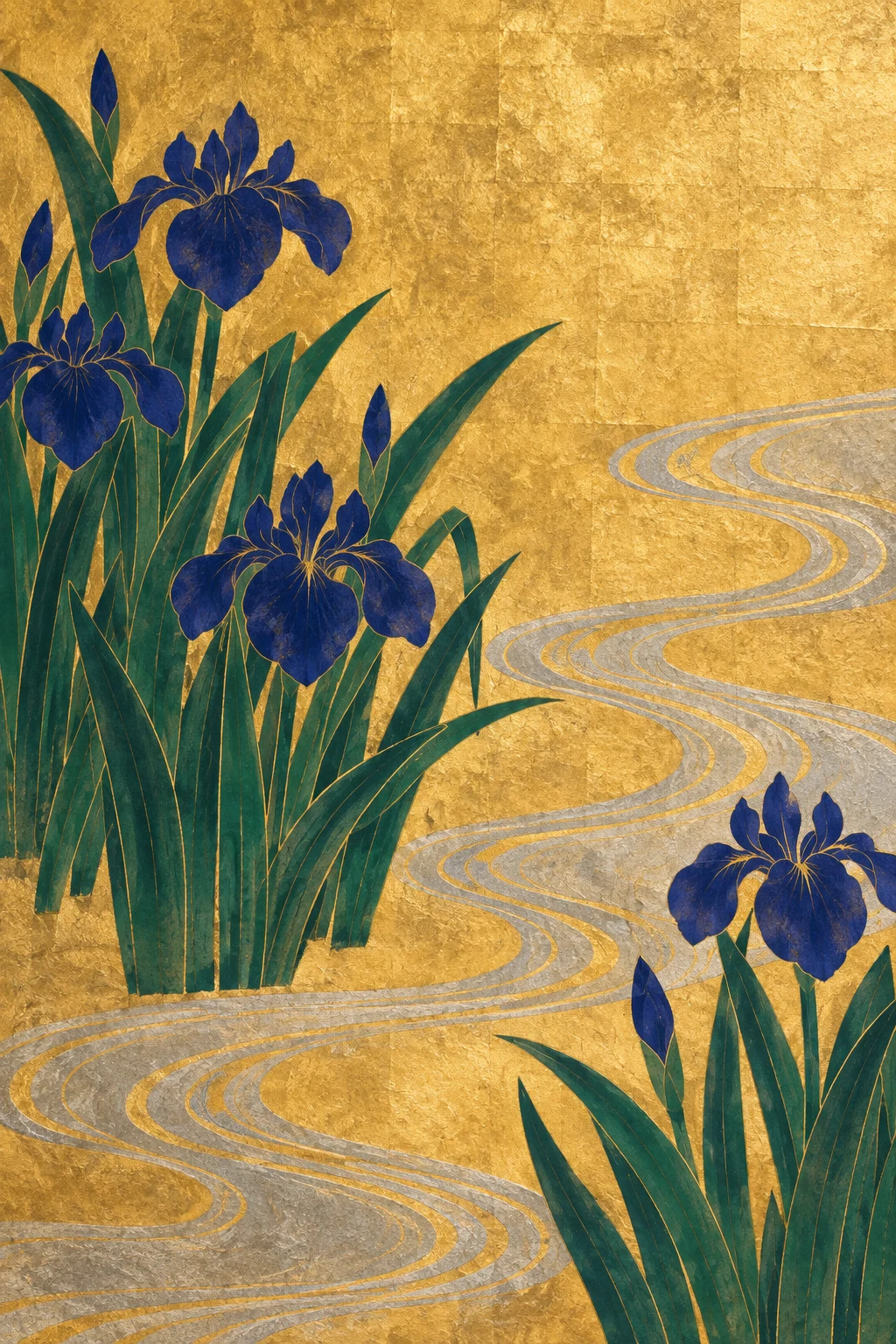
以下是对本页示意图的观察,不是所有琳派作品必须遵守的规则。它也不能代替原作的尺度、光泽与真实材质。
- 大片金色不是剩余背景。把目光放在左上花丛与右下花丛之间。那里没有新的花朵,却让两组植物能够相互呼应;如果填满这片空处,流动感会怎样改变?
- 水纹带着视线转弯。顺着银色曲线,从画面下方往右上走。注意它何时靠近边缘、何时回到中间,观察它与花叶形成的距离,而不只把它当作装饰线。
- 相似的花没有均匀排队。比较几朵蓝色鸢尾的大小与朝向。重复让它们属于同一个视觉家族,间距变化则让画面不变成规则壁纸。
纸上练习 · 编辑部原创
给一张邀请卡留出呼吸
拿一张纸,只写活动名、地点与日期。在另一张小纸上画三片简化叶子,试着把它们集中在一角,给文字保留一块连续空处。先不使用金色,判断植物的走向能否把视线引向标题。
然后只移动一片叶子,比较两版:哪一版让信息更容易找到?哪一处空白最重要?这是借用构成关系的练习,不是复制一件琳派作品,也不是 App 内自动生成设计的功能。
换一种角度比较
同样平面化,为什么感觉不同?
打开浮世绘,可以比较轮廓、色面与人物或场景的叙事关系。再看克里姆特式金色装饰,不要只因为都有金色就把两者视为同一语言。这些是帮助观看的比较方向,不是在声称流派之间存在未经证实的直接影响。
想练习另一种空白,可以读瑞士风格的网格与层级:它让空白组织信息,琳派教学图则让空处连接植物与曲线。同一种构成问题,可以有不同的表达方式。
关于琳派的三个问题
琳派一定用金色吗?
不是。不要把常见表面特征当作必要条件,应结合具体作品、材料与历史语境来理解。
这张封面能当作尾形光琳原作吗?
不能。它是 Style Atlas 的教学示意图;历史作品请通过下方馆藏资料辨认作者、年代与媒介。
这里是 App 的完整琳派指南吗?
不是。本页是独立的免费编辑文章。图鉴中琳派主图与简介免费,完整学习档案属于 Plus;20篇免费完整档案包含瑞士国际主义、包豪斯等其他条目。
Rinpa: read the intervals, not just the gold
Rinpa, also written Rimpa, brings flowers, seasonal imagery and decorative surfaces into a composed visual rhythm. For a designer or a curious viewer, the useful question is not simply whether a picture looks Japanese or uses gold. Ask how open areas connect its shapes and how repetition changes across the surface.
The Met's Rinpa essay traces relationships among Hon’ami Kōetsu, Tawaraya Sōtatsu and Ogata Kōrin, across painting and decorative media. It explains why the label should not be mistaken for one continuous hereditary workshop. Nature, seasons and literature matter alongside surface pattern.
For a historical object, visit the museum record for Kōrin's Irises at Yatsuhashi (Eight Bridges), dated after 1709. Study its extended folding-screen format. The portrait illustration on this page is our digital teaching image, not that screen, a reproduction of it, or evidence of historical materials.
Three relationships in our teaching image
Begin with the large gold-colored opening between the plant clusters. It does not need another flower to become active. Its changing width allows the left and lower-right groups to answer each other. Imagine filling it with equally dense detail, and ask what movement would disappear.
Next, follow the silver-colored curves upward. Notice the distance between water and stems rather than looking for a single symbolic meaning. Their turns give the eye a route through the page without dividing it into evenly sized compartments.
Finally, compare repeated blue flowers. Shared color unifies them, while changing orientation and spacing prevent a mechanical repeat. These are observations about this particular image, not a checklist that authenticates every Rinpa object. A screen's scale, reflective ground and changing light cannot be fully conveyed by a phone display.
A layout exercise without a gold shortcut
Draft an invitation using only a title, date and place. Draw three simple leaf shapes separately and gather them near one corner. Keep a continuous opening for the words. Work in black and white first so the structure must stand without the attraction of metallic color.
Move just one leaf and compare the two arrangements. Which opening helps you find the title? Which shape interrupts the route? Use your answer to choose a direction, rather than judging by how much decoration a version contains. This is an original editorial exercise in relationships; it does not make a finished design for you or reproduce the full in-app guide.
Compare questions, not labels alone
Look at Ukiyo-e for another way contour and flat color can serve a subject. Compare Klimt's decorative language without treating every golden surface as equivalent. These are viewing prompts, not claims of direct historical influence.
Our Swiss Style introduction asks a parallel question about empty space and information. Rinpa's intervals can organize flowers, while a typographic layout can organize a reader's next step. The purpose and context still matter.
Is gold compulsory?
No. A recurring material or appearance is not a definition of every work. Look at the specific object's medium and setting.
Is this a historical artwork?
No. Our cover is an original AI-assisted teaching illustration. Historical objects and their records are linked separately.
Is the complete Rinpa archive free?
This editorial article is free to read. Rinpa's hero and introduction are free in the atlas; its complete archive requires Plus. Twenty other complete archives, including Swiss Style and Bauhaus, are free.
Sources · 资料与延伸阅读
回到机构资料看原作
- The Metropolitan Museum of Art — Rinpa Painting Style:历史语境、艺术家关系与媒介。
- The Met — Ogata Kōrin, Irises at Yatsuhashi (Eight Bridges):独立馆藏记录,非本页封面。
资料核实于 2026-10-21。本文观察与练习由 WonderElian Editorial 撰写;机构链接不代表机构为本产品背书。